
Our CBD Pet Drops are a natural, safe, and effective way to support your furry friend's overall well-being. Made with high-quality CBD oil…
$24.99each
Quantity
1
25% OFF WITH CODE
Limited-Time Sale | Ends November 15 at 7 PM PSTOne-time purchases only.Shop Now

Pet CBD products are popular and poorly regulated. Here is what is known, what is not, and how to approach the decision with your veterinarian rather than a label.
By the BuyLegalMeds team11 min read
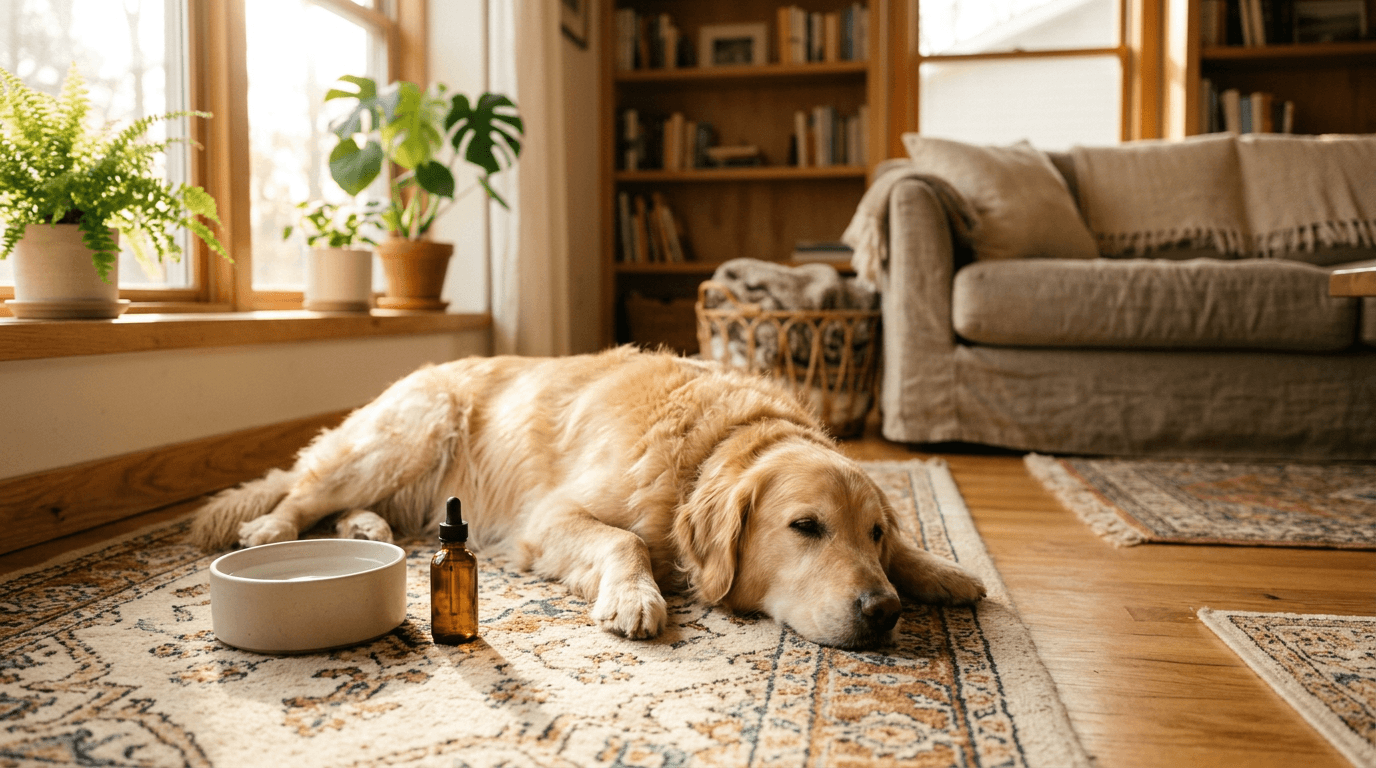
Many pet owners come to CBD the same way people come to it for themselves: through a friend, a social post, or a store display. Pet products are among the fastest growing corners of the hemp market, and the packaging is persuasive. Photos of happy dogs, friendly language, and a small bottle with a dropper make it feel as routine as buying a treat. But the regulatory picture for animals is thinner than it is for people, the research is limited, and an animal cannot tell you how it feels.
This guide is written for pet owners who want an honest overview. It explains what regulators have said, how pet product labels work, what the safety questions are, why THC is a particular concern in animals, what to do if a pet gets into a product, and what to ask a veterinarian. It does not give amounts, and it does not say that CBD will do anything for your pet. Your veterinarian knows your animal, and this guide cannot replace that relationship.
The FDA regulates animal products as well as human ones. The agency has said that it has not approved any CBD product for use in animals, and that it has not evaluated over-the-counter pet CBD products for safety or effectiveness. In its consumer information on cannabis-derived products, the FDA also notes that it has limited data about the safety of CBD in animals and that more research is needed.
Under federal law, a product intended to treat, cure, or prevent disease in an animal is generally considered an animal drug, which requires FDA approval before it is marketed. That is why responsible pet products avoid disease claims, and why you should be cautious of any product that promises to treat a condition in your animal. The FDA has sent warning letters to companies marketing CBD for animal health conditions.
Pet food and treats have their own rules. State feed control officials, working with the Association of American Feed Control Officials, set standards for what can be added to animal feed, and hemp-derived ingredients have not been generally approved as feed ingredients. That is part of why the status of pet CBD is described as unsettled.
In practical terms, this means a pet CBD product is made and sold in a gray area. It is not necessarily unsafe, but the usual regulatory checks on quality and claims are limited, and the responsibility falls more heavily on the seller and on you.
Studies of CBD in animals exist, mostly in dogs, and they are small and varied. Some have examined how dogs process CBD and what side effects appear, and some have explored specific conditions. The results do not add up to a clear, reliable picture that applies to every animal and every product. Researchers and veterinary organizations generally describe the evidence as preliminary.
Several points follow.
The honest summary is that nobody can promise that CBD helps a particular pet, and nobody can promise that it is harmless.
Shop this topic
Our CBD Pet Drops are a natural, safe, and effective way to support your furry friend's overall well-being. Made with high-quality CBD oil…
$24.99each
Veterinarians who have studied CBD in dogs have reported side effects in some animals, such as digestive upset, drowsiness, and changes in liver enzyme measurements on blood tests. The liver finding matters because many animals take other medicines processed by the liver. This is a reason to involve a veterinarian before starting a product, and to ask about monitoring.
CBD can affect enzymes that process many drugs. If your pet takes prescription medication, including seizure medication, pain medication, or anything with a narrow safety margin, adding CBD may change how those medicines work. Do not add any supplement to a regimen without telling the prescribing veterinarian.
Pets with liver disease, kidney disease, or other chronic conditions may respond differently, and an animal that is already unwell needs a diagnosis, not a supplement. If you are considering CBD because your pet seems uncomfortable, anxious, or ill, the first step is a veterinary evaluation. Delaying a diagnosis for a supplement can be harmful.
There is very little information on use in pregnant or nursing animals or in young animals, and caution is warranted. Ask a veterinarian before giving any product to these animals.
Pet products can contain ingredients that are harmful to animals. Several common human food additives are dangerous to dogs, including xylitol, a sweetener found in some products, which can cause a rapid drop in blood sugar and liver failure. Some essential oils and flavorings are harmful to cats. Never give a human gummy or edible to a pet without confirming every ingredient, and read the ingredient list of any pet-labeled product carefully.
Dogs and other pets are more sensitive to THC than people are. Veterinary poison control services have reported rising cases of THC toxicity in dogs, often from accidental ingestion of edibles, flower, or products left within reach. Signs can include unsteadiness, dribbling urine, lethargy, vomiting, a slow heart rate, and in severe cases, tremors or coma.
Because some CBD products contain small amounts of THC, and some products labeled CBD are mislabeled, the THC content of any product you give a pet matters more than it would for a person. A full-spectrum product, which contains small amounts of THC, is not the same risk as an isolate or a product with THC not detected on a lab report. Our guide to isolate, broad spectrum, and full spectrum covers how to tell the difference.
Hemp-derived THC products, including delta-8 and delta-9 gummies, are never appropriate for pets. If you own any THC product, store it where animals cannot reach it, ideally in a locked container.
Reading a pet label uses the same skills as reading a human one, with extra attention to a few details.
Like human tinctures, pet drops list the total milligrams of CBD in the bottle, and the bottle size and serving determine how much is in each dropper. The ACTIV8 CBD Pet Drops in our catalog are listed in 325mg and 1,000mg versions. The headline number is the total in the bottle, and what matters is the concentration and the serving size stated on the label. Our tinctures guide shows the arithmetic.
A good label states which animals the product is intended for and gives directions. Be wary of a label with no species listed, or one that treats all pets the same. If a product is not labeled for your type of animal, do not assume it is suitable.
Read the full ingredient list. Look for the carrier oil, flavorings, and any added ingredients. Flavored products may use ingredients that appeal to animals, which is also why storage matters.
Check whether the product uses isolate, broad-spectrum, or full-spectrum extract, and what the lab report says about THC.
Match the lot number to a lab report, and compare the measured CBD to the label. Look for a contaminant panel, since pets are small and sensitive to contaminants. Our lab report guide explains each step.
Be wary of claims that a product treats anxiety, arthritis, seizures, cancer, or any condition. Those are disease claims that the FDA has said are not appropriate for unapproved products, and they are not supported by reliable evidence for these products.
Pets are curious and have strong noses. Flavored drops, treats, and chews can be irresistible.
A visit is the most useful step. Here are questions to bring.
Veterinary opinions on CBD vary, and some veterinarians are cautious because of the regulatory situation. Laws in some states also limit what a veterinarian can say about cannabis. A good conversation can still cover safety, monitoring, and alternatives.
Be willing to hear that CBD is not the right choice. If your pet has a condition that needs treatment, a proven treatment is usually the better route, and a supplement is not a replacement.
Pets are not small people, and the species matters more than most labels admit.
Dogs are the animals studied most often, which is why most of the limited information you will read concerns them. Even so, breed, size, age, and individual health vary a great deal, and sensitivity to THC is well documented. Small dogs are at higher risk from accidental ingestion simply because a given amount is a larger share of their body weight.
Cats lack some of the liver enzymes that other species use to process certain compounds, so they can react differently to substances that are fine for dogs or people. They also groom themselves and can ingest topical products from their fur. Do not apply human or dog products to a cat, and ask a veterinarian before giving a cat any hemp product.
Rabbits, birds, reptiles, horses, and small mammals each have their own physiology and their own risks. For these animals there is even less information, and a product labeled for dogs should not be assumed to be appropriate. Horses used in competition may also be subject to rules about prohibited substances.
Young animals are still developing, and older animals often have reduced liver or kidney function and take multiple medicines. Both groups need a veterinarian involved before anything new is added.
Animals that work, compete, or provide service may be subject to testing or rules set by their organizations. Check those rules before giving any cannabinoid product.
Contact a veterinarian promptly if, after your pet receives any hemp or cannabinoid product, you notice any of the following:
Bring the product packaging, the lot number, and any lab report. Tell the veterinarian exactly what your pet received and when, since that speeds up treatment. Do not try to induce vomiting at home unless a veterinarian or poison control service tells you to.
If you are considering a pet product, a responsible approach looks like this.
You can look at the pet drops in our catalog, and compare their label and any posted lab information against the checklist above.
Loving a pet makes the idea of a simple fix appealing. The honest position is that the research on CBD in animals is limited, the regulation is incomplete, and quality varies. That does not mean no pet owner should ever consider it. It means the decision belongs in a conversation with a veterinarian who knows your animal, backed by a product that discloses what is in it, and supported by watchfulness and safe storage. If you ever suspect your pet has eaten something it should not have, treat it as urgent and call for help right away.
No. The FDA has said it has not approved any CBD product for use in animals and has not evaluated over-the-counter pet CBD products for safety or effectiveness.
Research is limited and mostly in dogs. Some animals show side effects such as digestive upset, drowsiness, or changes in liver values, and cats process many substances differently. Talk with your veterinarian before giving any product.
Dogs and other pets can be more sensitive to THC than people, and THC toxicity from accidental ingestion is a recognized problem. Choose products with THC clearly disclosed or not detected, and never give pets hemp-derived THC products.
No. Human products may contain ingredients that are harmful to animals, such as xylitol, and may contain THC. Use only products labeled for your type of animal, and check with your veterinarian.
Contact a veterinarian, an emergency animal hospital, or an animal poison control service immediately, and bring the package with you.
These statements have not been evaluated by the Food and Drug Administration. These products are not intended to diagnose, treat, cure, or prevent any disease. This article is for general education only and is not medical advice. Talk with a qualified healthcare professional before using any new product, especially if you are pregnant, nursing, or take medication.
Our CBD Pet Drops are a natural, safe, and effective way to support your furry friend's overall well-being. Made with high-quality CBD oil…
$24.99each
CBD Tinctures11 min read
A tincture label shows one big number, and that number is easy to misread. This guide explains concentration, carriers, flavors, storage, and how to compare brands fairly.

Quality & Testing11 min read
A lab report is only useful if you know what to look for. This guide walks through a certificate of analysis section by section and flags the warning signs.
CBD Basics12 min read
New to CBD? This guide explains what the word means, how products differ, how to read a label without getting tripped up by milligrams, and what to check before you buy.

You must be 21 or older to enter.
By entering you agree to our Terms of Service and Privacy Policy.